
Article
Pricing as a strategic lever: 14 building blocks for commercial leaders
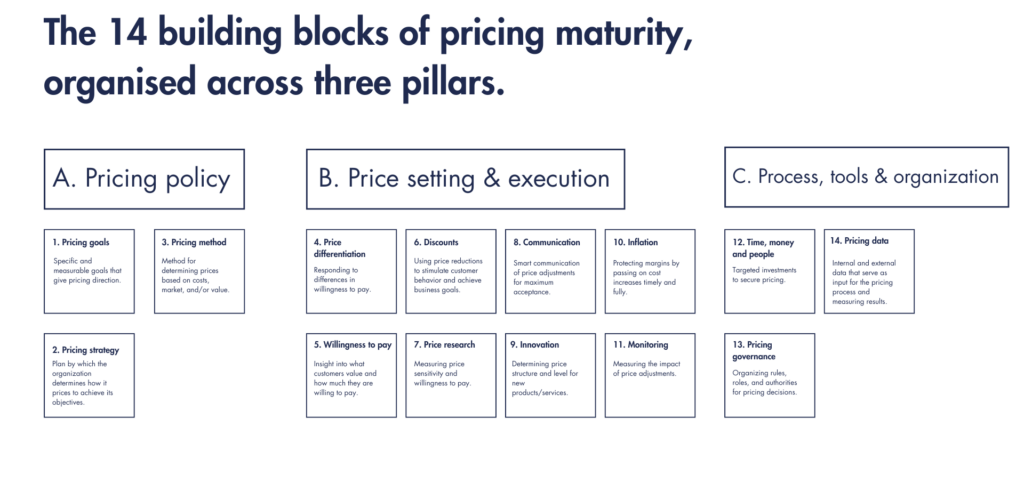
Pricing looks simple from the outside. Set a price, bring it to market, adjust when needed. But behind every strong pricing organisation is a structure most companies have never built. Our State of Pricing research, conducted among pricing professionals across the Netherlands and Belgium, identified exactly what that structure looks like. It comes down to 14 building blocks of pricing maturity, organised across three pillars: pricing policy, price setting and execution, and the foundations that hold it all together.
These building blocks are not a theoretical framework. They are a mirror. Each one reveals a specific area where organisations either leave value on the table or pull ahead of the competition. And according to our State of Pricing research, the average maturity score across the 14 building blocks sits at 6.4 out of 10. That gap is not a coincidence. It is the result of specific, identifiable weaknesses that show up consistently across companies of all sizes and sectors.
Pricing policy: do you know where you are going?
The first pillar is about strategic direction. It covers three building blocks: pricing goals, pricing strategy, and the method organisations use to determine prices. These three form the foundation for everything that follows. Without them, pricing decisions happen in a vacuum.
Most organisations skip this step. They set prices reactively, based on what competitors charge or what costs allow. The frontrunners do it differently. They start with a clear goal. Do they want to grow margin? Improve price perception? Increase market share? That goal then shapes every pricing decision downstream.
Aegon is a strong example of what this looks like in practice. Their central pricing team had one clear mission: add as much value as possible to the organisation. Each business line then set its own direction, choosing between steering on margin or volume. Progress was tracked and discussed regularly in a dedicated pricing board. That clarity and structure changed how the entire organisation thought about price, and made pricing decisions faster, more consistent, and easier to evaluate.
The method used to set prices matters just as much. Value-based pricing, which starts with what customers actually value and what they are willing to pay for it, consistently outperforms cost-plus logic. Yet most organisations still do the opposite: they calculate costs, add a margin, and work outward from there. The result is a price that reflects internal reality rather than customer value.
Price setting and execution: where most value is won or lost
The second pillar is the largest, covering eight building blocks. This is where strategy meets the market. It includes how organisations handle price differentiation, willingness to pay, discounts, price research, price communication, innovation pricing, inflation, and monitoring. It is also where the gap between frontrunners and the rest is most visible.
Most organisations underperform across several of these building blocks at the same time, which compounds the impact. A company that lacks insight into willingness to pay, for instance, will also struggle to differentiate prices effectively. And a company that does not measure the impact of its pricing decisions cannot learn from them.
Take price communication as one example of how much room for improvement there is. According to our State of Pricing research, only 14% of organisations have fully optimised how they communicate price changes to customers. Yet framing and timing can make the difference between a price increase that lands well and one that triggers churn. When Slack raised their prices, they did not announce a higher cost. They reframed it as an expansion of value, reminded customers it was the first increase in eight years, and offered existing users the chance to lock in the old rate. The number did not change. The story around it did. The result was a price increase that felt justified rather than frustrating.
Every one of the eight building blocks in this pillar holds that kind of potential. And for most organisations, there are multiple areas within this pillar alone where meaningful improvement is within reach.
Process, tools and organisation: the foundation that makes it stick
The third pillar is often the most overlooked. It covers three building blocks: the time, money, and people invested in pricing, pricing governance, and pricing data. Without these in place, even the strongest strategy will fall apart in execution.
Pricing governance is a good example of how far most organisations still have to go. More than one in five companies has no formal guidelines at all for how pricing decisions get made. Another large group relies on informal habits that have never been documented. The result is inconsistency. Different teams apply different logic. Discounts get approved without clear criteria. Pricing changes happen without proper review.
Pricing data tells a similar story. Only 28% of companies has the right pricing data and uses it effectively for commercial decisions. The rest either lacks the data entirely or has it sitting somewhere unused. Without a solid data foundation, it is impossible to separate the impact of a pricing decision from the noise of the market around it. You end up making decisions based on gut feel rather than evidence, and you have no way of knowing whether your pricing is actually working.
The bottom line
-
The 14 building blocks of pricing maturity give you a structured way to see exactly where your organisation stands and where the biggest opportunities lie. Some organisations will find their gaps in strategy. Others in execution. Most in the foundations that are supposed to support it all.
-
What makes this framework valuable is not just the diagnosis. It is the direction it gives. Once you know which building blocks are holding your pricing back, you know where to focus. And even targeted improvements in one or two areas can have a significant impact on profitability.
Want the full picture?
Download our State of Pricing report for an in-depth look at all 14 building blocks, including benchmarks, cases, and practical guidance.
For a deeper dive, watch the replay of our webinar and discover exactly how frontrunners are closing the gap.