Article
Being visible is no longer enough
Visibility is no longer the scarce resource. Being remembered is.
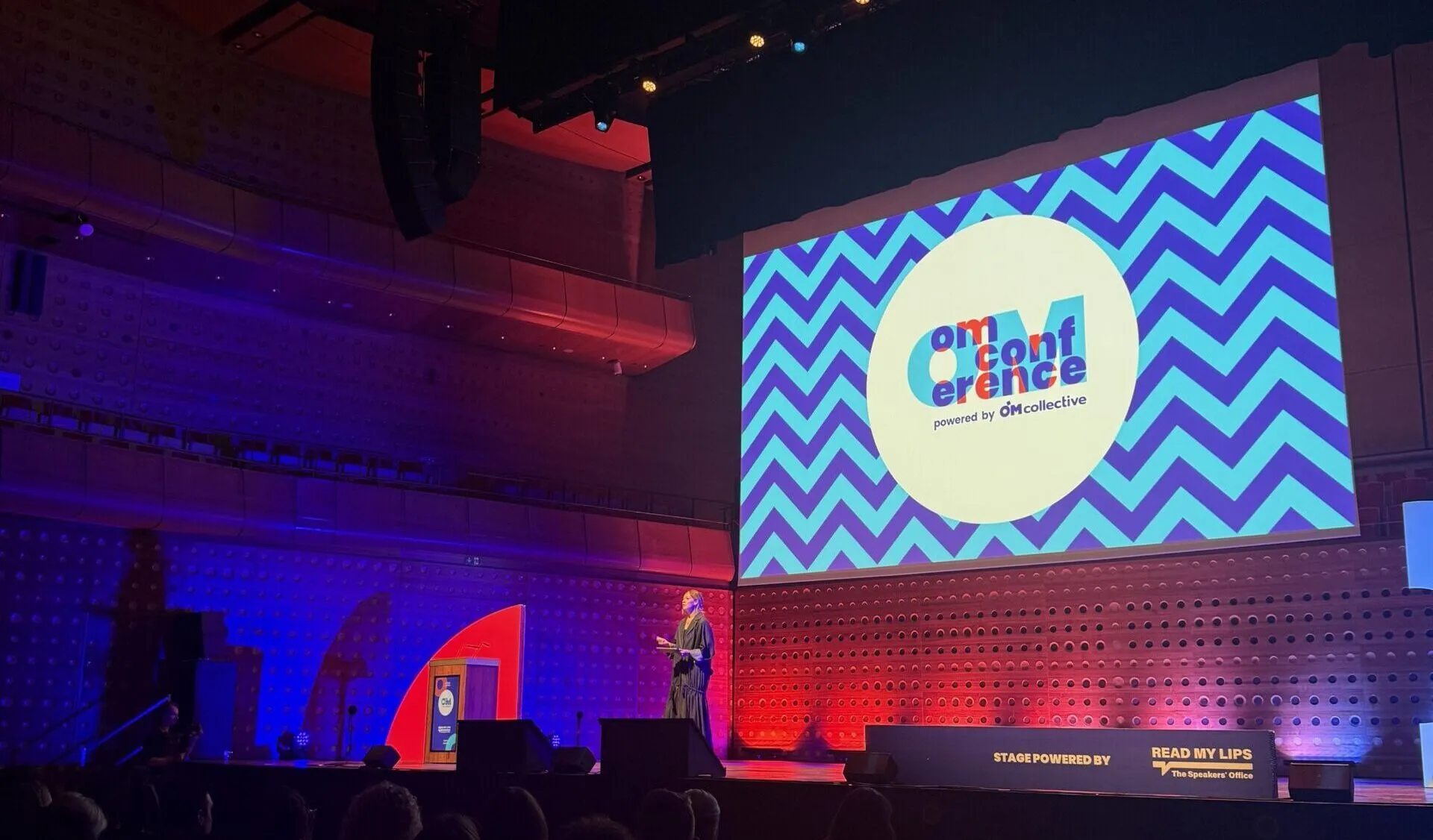
That was the common thread running through the six keynotes we attended at this year’s OM Conference in Antwerp. From sonic branding to AI search, from presentation craft to customer loyalty, the topics looked very different on paper.
In practice, they all pointed in the same direction. In a world where content is everywhere and AI increasingly shapes what people see, read and trust, visibility alone is no longer enough. The real challenge is becoming memorable, both for people and for machines.
Before we dive in, a small confession. One of the conference sessions focused on how to make content more likely to be cited by AI search engines. As we wrote this article, we caught ourselves following the playbook almost line by line: expert quotes, hard numbers, clear structure, comprehensive answers and, yes, English rather than Dutch. Consider this both a conference recap and a real-life experiment. We’ll let the algorithms decide whether it worked.
Here is what stayed with us, and what we are going to do about it.
1. From attention economy to memory economy
Marc Fauconnier opened with a painful piece of arithmetic. Global ad spending runs to $1.1 trillion, of which 73% is digital or retail, and 91% of that is programmatic. Against that: 17% of consumers can recall the brands they have encountered. Enormous input, poor memory.
He quoted Herbert Simon: “A wealth of information creates a poverty of attention.”
Mental availability is under pressure.
His proposal: shift from an attention economy to a memory economy. Not measured in seconds and clicks, but in unprompted recall. Not rented from a platform, but owned in minds, culture and systems.
This memory economy consists of three kinds of memory:
- Biological memory: deep encoding based on emotion and creativity.
- Collective memory: some promises are not kept by the brand alone, but by everyone else.
- Algorithmic memory: not top of mind, but top of retrieval: what machines match with our behaviour.
His principles, in short: memory over attention, promise over message, fame over flash, architecture over identity, co-production over campaign, marathon over sprint.
And the line that got a laugh before the room went quiet: “CMO no longer stands for chief marketing officer, but for chief memory officer.”
2. Citability, not visibility
Two keynotes arrived at the same point from completely different directions.
Marc Fauconnier: “AI is about citability, not visibility.”
You are not remembered because you are visible, but because others cite you. That takes a clear position, real depth and years of consistency.
Michel De Boer and Pieter Serraris of OM Collective got there with hard numbers. 77% of people trust AI search as much as or more than traditional search. Brands that are well embedded in training data show up as much as 70 times more often than brands that are not. They also analysed nearly 400 brand websites from companies represented at the conference and found that 21% block at least one AI bot, meaning they cannot be cited at all.
Beyond being included in training data, brands need to answer the full question landscape rather than only the basic query. A single question often brings six or seven relevant follow-up questions. The objective is not simply to answer a query, but to become the source AI chooses to reference.
Some practical recommendations to become more citable:
- Answer the full question landscape, not just the primary query.
- Use clear figures, statistics and expert quotes.
- Present information in a structured way.
- Keep content up to date and regularly review older articles.
- Repeat key evidence and proof points consistently across your content.
- Consider publishing strategic content in English, as English-language content is cited approximately 2.6 times more often.
- Make your website agent-ready so AI systems can easily access and understand your content.
- Ensure your website complies with the European Accessibility Act and follows accessibility best practices.
The lesson is the same on both sides: Make sure you are the answer, not that you are standing near it.
“A wealth of information creates a poverty of attention.”
Herbert Simon
3. And then the uncomfortable prediction
Steven Van Belleghem closed with the locksmith paradox.
A locksmith opens your door in one minute and charges €200. Fifteen years ago that took time and effort, and the price felt fair. Now it feels like theft: same result, less visible work.
AI is going to do the same to a large share of what we deliver. Less visible work, same price, unhappy customer.
On top of that come zero search effort and agent-to-agent interaction. It is no longer the customer doing the comparing, it is their agent.
In that reality, the question is not only how brands retain customers, but what kind of loyalty they can still build.
Steven Van Belleghem distinguishes three levels of loyalty:
- Transactional loyalty: reinvent convenience. Customers choose the easiest, fastest option, but AI can quickly make this advantage interchangeable.
- Transformational loyalty: reinvent relevance. Brands earn trust by adding meaningful, personalised value beyond the purchase.
- Deep loyalty: reinvent belonging. Customers identify with the brand: “I identify with you” and remain connected even when cheaper or easier alternatives exist.
The goal is to move from convenience to relevance and ultimately to belonging.
This progression towards deep loyalty matters because his conclusion was blunt: Customer loyalty will decrease fast because of AI. That makes deep loyalty both harder to measure and more important than ever.
“I’ve learned that people will forget what you said, people will forget what you did, but people will never forget how you made them feel.”
Maya Angelou
4. The personality gate
Amid all the algorithmic firepower, one keynote stopped to consider the human behind the output.
Emma Declerck, a former THoMer, showed how she works as an AI-first marketer: not with scattered prompts, but with a shared workspace where she and AI work on the same material.
The part that stuck with us is what she calls her personality gate: a fixed check on everything that comes out.
- Is this what I want to say?
- Is this who I am?
- Does it position me the way I want to be positioned?
- Does it have enough soul?
If your brand depends on being remembered, that is not a cosmetic step at the end.
That is the step where the difference gets made.
5. Sonic branding: cutting through the noise with sound
Sonhouse, an audiovisual studio and talent network, reminded us that sound reaches people before thought does.
An alarm puts the body on alert. Birdsong slows us down. A catchy melody stays.
Even in a wine shop, playing French music was enough to make French wine sell out.
That is why sonic branding is more than a jingle. It translates the brand feeling into a recognisable sound world: a sound logo, campaign music and audio cues across ads, podcasts, stores and other touchpoints.
Consistent enough to be remembered. Flexible enough to travel.
What stayed with us: Sound only becomes a brand asset through consistency.
McDonald’s weakened recognition by changing too often.
Intel did the opposite, building one of the world’s most recognisable sound logos, no small achievement for a B2B chip brand.
What we took away
Looking back, what struck us most was not how different the topics were, but how often they pointed to the same conclusion.
Memory. Citability. Loyalty. Authenticity. Sound.
Different words for a similar challenge. Being seen is only the start.
The real challenge is becoming remembered, trusted and retrieved, both in people’s minds and in the systems now shaping their choices.
Or, as several speakers reminded us in different ways: Visibility is no longer the scarce resource. Being remembered is.
Curious what this means for your brand?
Let’s start the conversation. Get in touch with us today to discuss a possible brand project.