
Article
Emerging marketing roles in the age of AI
No one trained to be a social media manager in 2010. By 2020, the role existed in virtually every marketing team. That parallel is worth keeping in mind as AI reshapes the marketing function today.
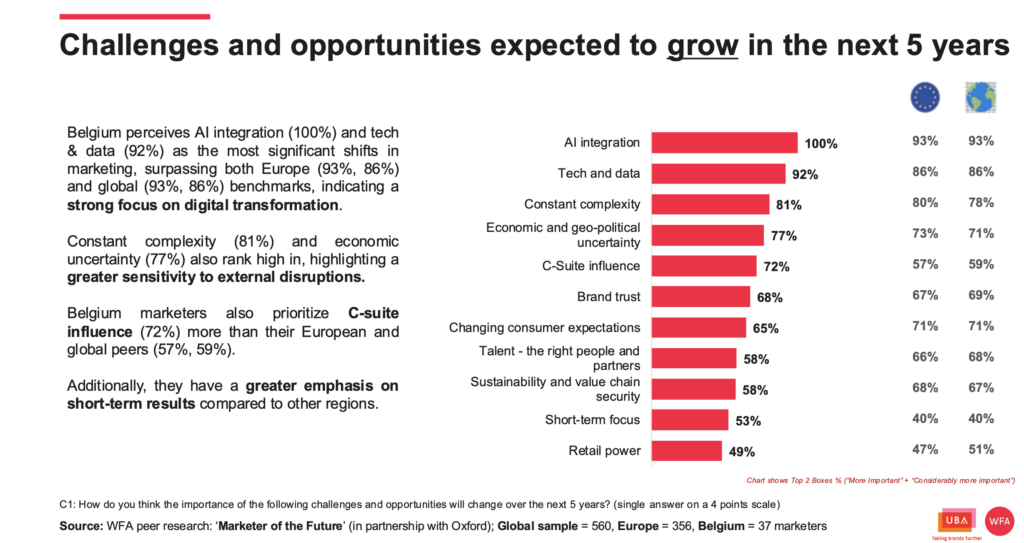
Data from Belgium makes the urgency concrete. In the WFA and UBA “Marketer of the Future” study, 100% of Belgian marketing leaders identified AI integration as the most significant shift expected in their field over the next five years. The highest score of any country in the study. When asked what new roles they would create if budget were no object, 45% pointed to AI, technology and innovation roles as the top priority. The demand is clear. The question is what these roles look like in practice.
Head of marketing & AI operations
The Head of Marketing & AI Operations sits above the day-to-day and looks at the full picture: which tools the team uses, how they talk to each other, where humans stay in control and where machines take the lead. They set the governance rules, define how performance gets measured across human-AI workflows and make sure the whole architecture delivers.
This is the role that stops AI from being a collection of disconnected experiments and turns it into a coherent, accountable system. Without it, you have tools. With it, you have a team.
AI marketing coordinator
Every system needs someone to keep it on track. At its core, the marketing coordinator’s role has always been about project management, editorial judgement and seeing campaigns through from brief to delivery. They combine analytical and creative skills while keeping the bigger picture in view. In an AI-powered team, those same skills apply to a new set of inputs. Briefs go to AI system. Outputs get reviewed for quality and brand consistency before they go live. Errors get caught before they scale.
The discipline the role has always demanded now operates at greater speed and higher volume. Coding is not required, but knowing when something is off is.
Prompt engineer
Ask most people what a prompt engineer does and they’ll say “someone who talks to AI.” That’s only a small part of it.
The real difference between average and excellent AI output is usually not the model. It is the instruction. Prompt engineers design those instructions. They are precise, structured, and goal driven. They turn vague requests into useful results.
Gavin Yi, CEO of Yijin Hardware, described prompt engineering as similar to early coding on the internet. A new language for a new technology, still mastered by few.
AI content generator
Good content has never been just about creating. It is about knowing what works, refining until it does, and making sure every word reflects the brand. That core skill set does not disappear in an AI-powered team.
What shifts is the starting point. Instead of a blank page, the AI Content Generator works from a draft. They direct the AI, push back on what misses and sharpen what doesn’t until the output meets the bar. The result is content at a volume and speed that would have required a full team just a few years ago, without dropping the standard.
The gap between this role and a traditional content creator is not talent. It is how the work gets done.
AI-enhanced creative director
Behind every strong campaign there is someone who decides what the work should feel like before a single asset is made. That is the Creative Director. The person responsible for translating a brand’s strategic ambition into a visual direction that holds across every channel and format.
AI does not change that responsibility. It changes the volume of material that lands on the desk. Not long ago, producing hundreds of visuals for a campaign took a full team and weeks of work. Now it can be done by one person who understands the tools. Where a team once produced a handful of options, generative AI produces dozens. The AI Creative Designer moves through them, defining the visual style, refining what’s close and cutting what doesn’t serve the vision. Taste, consistency, and strategic clarity become the bottleneck.
A Belgian senior marketer in the WFA/UBA study already put this into practice, referring to “a Creative Production Manager in charge of using GenAI for asset production” as a role that had just been created.
The title evolves. The core of the job does not.
AI analytics system manager
AI doesn’t just increase the amount of data available. It also raises the risk of misunderstanding it.
The AI Analytics System Manager ensures that doesn’t happen. They manage the intelligence layer behind AI decisions. They identify relevant signals, set priorities, and interpret what the data really means.
This is not just dashboard work. It is judgement work. AI can process huge datasets with confidence yet still draw the wrong conclusions.
Belgian marketers already see this gap. The WFA/UBA study highlights data literacy as the most urgent skill shortage in the country. Essential for the future, but still underdeveloped. What businesses need is not only people who read data, but people who question it.
Sustainable AI analyst
AI has an environmental cost, but most organisations don’t fully understand its scale.
Every model trained, image generated or automated recommendation delivered uses energy. That impact is becoming harder to ignore for regulators, investors and consumers. The Sustainable AI Analyst applies this logic directly to AI. They track usage, spot inefficiencies and ensure sustainability is considered when selecting and deploying tools. As AI becomes standard across marketing, this role moves from optional to necessary. Early adopters will be better placed than those who react later.
AI ethics officer and AI literacy educator
Two roles, one reality: many teams are using AI without fully understanding it. Legally, ethically or practically. In Belgium, 90% of workers are unaware of the AI laws that apply to their work and only 39% have received any training.
The AI Ethics Officer ensures organisations have clear rules for fairness, transparency, and compliance before issues arise. The AI Literacy Educator makes sure teams can use AI properly. Not just operate it, but interpret and question its output.
The WFA/UBA study confirms the priority: Belgian marketers rank learning and talent development (57%) above technology investment (43%). Without understanding, AI is not an advantage. It is a liability.
What this means for your team
-
None of these roles will appear fully formed on an org chart. At least not right away. Most organisations will evolve into them gradually, as AI becomes part of everyday work and responsibilities shift inside existing teams. Skills change first. Job titles follow later.
What connects all these roles is a shared foundation: strong marketing knowledge, practical AI fluency, critical thinking to challenge outputs, and the judgement to know when to question or correct the system. Ethical awareness is also key, especially when deciding what should not be automated.
-
The WFA/UBA study points to a T-shaped model: broad marketing expertise combined with deep capability in emerging areas like AI. At its core, it is driven by curiosity, adaptability, and a clear understanding of what marketing is meant to achieve.
In Belgium, 100% of marketing leaders see AI integration as the most significant industry shift.
The roles are changing. Is your team ready?
Not sure where to start? Take our self-assessment and find out whether you’re ready for AI or just using it.