Article
Not Going Back to “Normal”: The Top Change Management Trends in 2026 (AI & Beyond)
Unless you’ve been enjoying a multi-year digital detox, you’ve probably noticed that AI has moved from an “interesting experiment” to a full-blown boardroom topic at record speed. And yes, it will continue to dominate headlines well into 2026.
But this article is not just about AI.
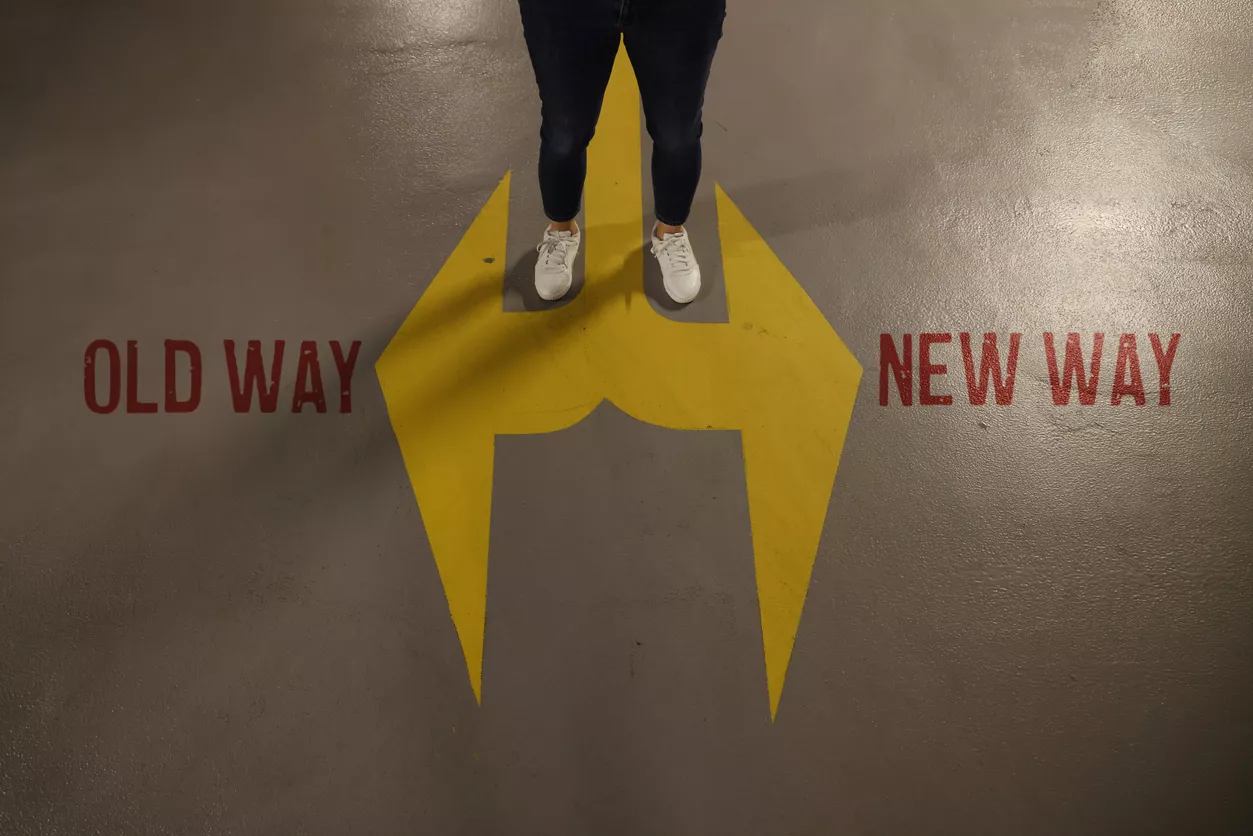
The post-COVID era has accelerated one of the biggest technology and work revolutions we’ve seen in decades. Yet in conversations with leaders across industries, one question still pops up surprisingly often: “So… when do we go back to normal?”
Here’s the uncomfortable truth: the pre-pandemic, pre-ChatGPT version of “normal” no longer exists. And even if it did, it shouldn’t be the holy grail.
Continuous change and uncertainty are no longer temporary disruptions — they are the operating environment. From geopolitics and economic fragmentation to marketing teams and everyday work, change is ever-present. While this creates real opportunity, it also brings real human strain. Our brains hate uncertainty, which is why transformation is ultimately a human challenge — not just a technology one. And when change management is not embedded into business strategy, change fatigue embeds itself into the workforce instead.
As consultants, we notice this every day, with almost every client. That’s why change management is a strong focus for us in 2026 and beyond — to help organizations not just define change, but make it stick. Below, we explore the key change management trends in 2026, why they should matter to you, and, most importantly, how to manage them without burning people out along the way.
Trend 1: Human-first, tech-second (yes, still)
Calling this a new trend might feel like a stretch. But in a world obsessed with speed, scaling, and automation, it remains one of the most frequently ignored principles.
Organizations keep rolling out AI tools and digital platforms at pace, often with impressive technical roadmaps, but surprisingly little clarity on what this actually means for people. Roles change faster than job descriptions. Skill expectations evolve faster than learning programs. And trust starts to erode when employees feel technology is happening to them, not with them.
A recent Harvard Business Review article captures this perfectly: “Most firms struggle to capture real value from AI not because the technology fails—but because their people, processes, and politics do.” If employees don’t understand how it fits into their work, their role, or their future – adoption will stall.
Common pitfalls we see
- Launching AI tools without a clear narrative on why, for whom, and with what safeguards
- Overreliance on dashboards and sentiment analytics, with little qualitative follow-up
- Assuming that “data-driven” automatically means “people-informed”
AI-powered sentiment analysis and listening tools can absolutely add value. But they are not a replacement for deep listening, informal sensing, and real conversations. If anything, AI insights should be the starting point — not the conclusion.
What leaders should do differently
- Anchor AI initiatives in a clear people narrative (roles, benefits, boundaries) and involve them from the beginning with a clear change roadmap
- Combine AI-driven insights with qualitative sensing and dialogue
- Invest explicitly in trust, transparency, and ethical literacy, not just tooling
Trend TL;DR*: Human-first isn’t soft. It’s how adoption actually happens.
- AI doesn’t fail because it’s too advanced. It fails because people aren’t brought along.
- Start every AI initiative with a people narrative before the tech roadmap: what changes, for whom, and what stays human.
- Use AI insights to ask better questions—not to stop asking them.
*too long, didn’t read – trend summary
Trend 2: Continuous change is the baseline, not the exception
By 2026, uncertainty is no longer something to “manage through.” It’s the baseline.
During COVID, organizations learned they can adapt quickly when needed. Agile ways of working, faster decision-making, rapid experimentation, hybrid & home working — all suddenly possible. The problem is what happened next: many organizations stayed in permanent transformation mode, without adapting how they manage change.
What used to be a sequence of transformations has turned into a constant stream. New tools, new structures, new priorities, new policies — often overlapping, sometimes conflicting, rarely paused. And still, many organizations manage these changes as if they were isolated projects.
Common pitfalls we see
- Running multiple transformations in parallel without a view on total change load
- Optimizing for speed and delivery while ignoring absorption
- Treating change management as a project task instead of a leadership capability
- Framing hybrid work and flexibility as “HR topics” rather than trust and adoption issues
What leaders should do differently
- Manage change as a portfolio, not a set of projects– and connect it to the company’s North Star goal
- Make someone explicitly accountable for connecting strategy, technology, and people impact – as a one-common-vision leader
- Use a small number of strategic change themes to help people make sense of what’s happening
- Treat ways of working as core adoption topics, not side policies
Trend TL;DR: Continuous change isn’t the problem. Uncoordinated change is.
- Stop managing transformations one by one — start managing the total change load.
- Make ownership explicit: someone needs to connect strategy, tech, and people impact.
- When everything is changing, direction towards the common goal beats speed.
Trend 3: Constant change + constant upskilling = very real change fatigue
AI-driven transformation is not a one-off reskilling exercise. It’s an ongoing capability shift—and for many employees, it’s starting to feel relentless.
Large job clusters are already being redefined, and many more will follow. The World Economic Forum’s Future of Jobs research shows that skill requirements are changing faster than organizations can reskill for, especially in roles affected by automation and AI.
Upskilling today has two equally important dimensions:
- Technical capability: learning to work with AI systems that often feel opaque or fast-moving
- Adaptive capability: coping with changing roles, processes, expectations, and success metrics
Add ongoing reorganizations, new tools, new ways of working, and external uncertainty and the human load adds up quickly. Change fatigue usually starts with saturation: too many changes at once, too little support. Over time, this shows up as disengagement, skepticism, anxiety, and eventually burnout or quiet resistance.
Common pitfalls we see
- Upskilling expectations increase, but space to learn does not
- Change initiatives pile up without coordination or prioritization
- People managers are expected to absorb the impact, without being equipped to do so
What leaders should do differently
- Be explicit about what people are expected to learn now versus later
- Equip people managers to coach through change, not just communicate it
- Create space for sequencing, reflection, and recovery, especially in long-running transformations
Trend TL;DR: If upskilling is continuous, support needs to be continuous too.
- Change fatigue isn’t resistance. It’s overload.
- People managers as change coaches: monitor learning and change load, not just rollout plans.
- Sometimes progress comes from slowing down, not pushing harder.
So, what does all this mean for 2026?
Key takeaways from change management trends in 2026
Across all three trends, the pattern is clear: change isn’t slowing down, AI isn’t going away, and people are feeling the weight of it.
That’s why “all managers are change managers” isn’t a slogan anymore — it’s simply reality. When teams are expected to adopt new tools, reskill continuously, and keep moving without clear pauses, leaders become the main anchor. Not by pushing change harder, but by helping people make sense of it. That takes a different balance of mindset, skills, and tools.
- The mindset to navigate change instead of trying to control it: being clear on what matters now, what can wait, and how today’s change fits into the bigger picture.
- The skills of reading change load, spotting fatigue early, and embedding change management into strategy, not treating it as an afterthought.
- The right tools to support it all: practical ways to listen, prioritize, and create adoption in day-to-day work, used consistently, not parked in a transformation deck.
The organizations that will stand out in 2026 won’t be the ones changing the fastest, but the ones changing most humanely. The ones that take the human experience seriously, especially when everything else keeps shifting.
If this sounds familiar, you’re probably dealing with it already. And if it feels a bit overwhelming, well, you’re definitely not alone. As marketing and change management consultants, we’ve helped many organizations make change and strategy work in practice — making sure it doesn’t stop at a slide deck, but actually sticks.
Curious how this translates to your organization or have any questions? Schedule a no-obligation 30-minute call here with one of our experts to talk it through and see how we can help!
Authors of the article
-

Iryna Nykytiuk
Consultant
- Global Marketing Strategy
- Change management
- Digital Marketing
- Project & stakeholder management
- Intercultural communication
-

Loes Janssen
Senior Manager
- Design Thinking & Value Proposition Consulting
- Brand Management
- Go-To-Market Strategy
- Organizational Design & Coaching
- Project Management
- Trade Marketing
-

Stéphanie Van Meerbeeck
Consulting Manager
- Organizational Design
- Change Management
- Business Transformation
- Value Proposition Design
- Project Management